
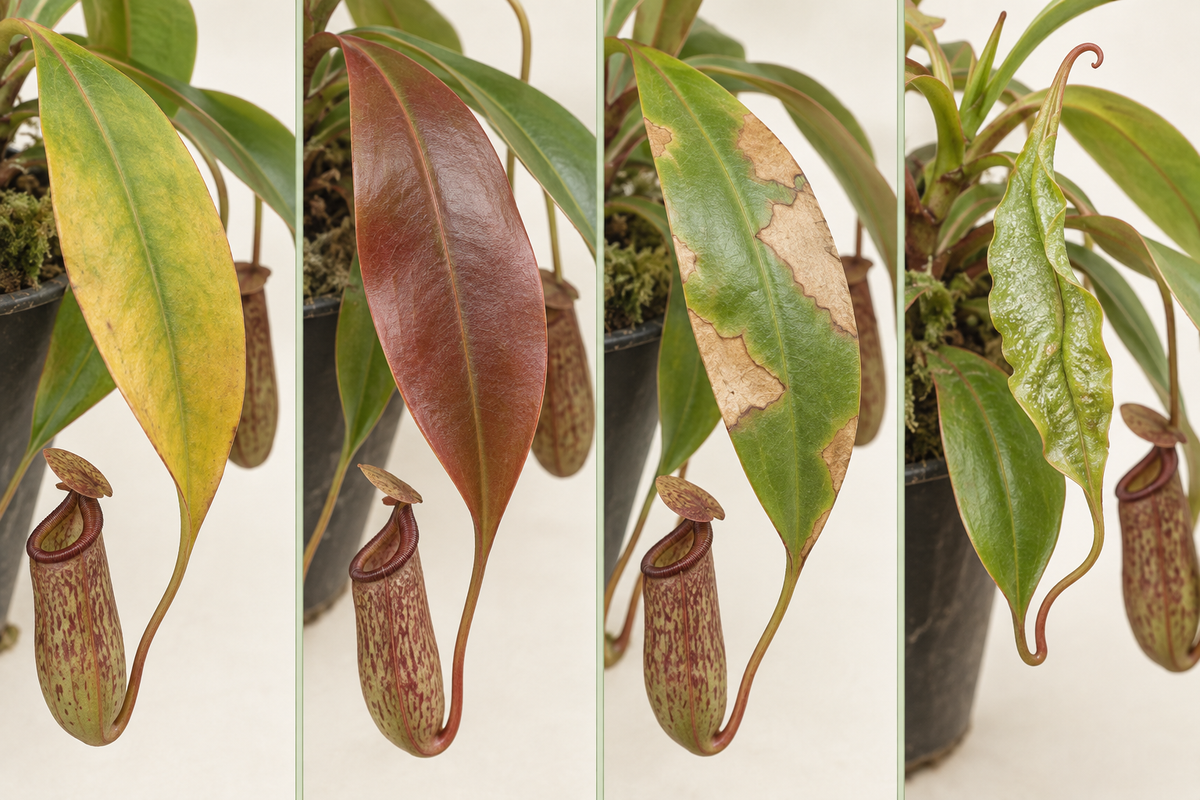
Leaf-color diagnostic table
| Pattern | Most likely explanation | Best next check |
|---|---|---|
| Oldest lower leaf slowly turns yellow, then brown | Normal leaf aging | Confirm that the growth point and newest leaf remain firm and keep increasing in size. |
| Several older leaves yellow together while media stays wet | Root-zone stress or compacted media | Check drainage, smell the media, and note how long the pot stays saturated. |
| New leaves emerge pale or progressively smaller | Active stress—not simple aging | Inspect roots, pests, temperature, light, and water quality. |
| Even red or bronze color on exposed surfaces | Often protective pigmentation from stronger light | Look for firm growth and gradual color rather than bleaching. |
| Sharp tan or brown patches after a light increase | Sun or heat scorch | Reduce the jump in intensity and acclimate gradually. |
| Fine stippling, silvery scars, distorted new growth, or black specks | Possible mites or thrips | Use a hand lens and inspect the growth point and leaf undersides. |
| Black, soft tissue spreading from the stem or growth point | Possible rot or cold injury | Isolate the plant and inspect the stem and root zone promptly. |

AI-generated educational illustration: four leaf-color patterns for comparison. Diagnose the whole plant and recent growing history, not color alone.
Diagnose the pattern before changing care
- Mark the affected leaves. Old damage will not turn green again; use the next one or two leaves to judge recovery.
- Check the timeline. Shipping, repotting, a new grow light, a cold night, or an HVAC change often explains a sudden shift.
- Inspect the growth point. Damage concentrated on tender new tissue raises pest or environmental concerns.
- Check the root zone. Media that has collapsed, smells sour, or stays waterlogged can create yellowing even when the top looks moist and healthy.
- Change one major variable at a time. Multiple simultaneous changes erase the evidence you need to identify the cause.
A Nepenthes leaf changing color does not automatically mean the plant is sick. The useful question is which leaves are changing, how quickly, and what changed before it started?
Red or bronze leaves
Some Nepenthes develop red, purple, or bronze pigmentation under stronger light, and genetics strongly influence how much color appears. If new growth remains firm and healthy, gradual reddening can be normal. Sudden bleaching, crisp patches, or damage shortly after a move to stronger sun is different and can indicate light or heat stress.
Yellow leaves
One of the oldest lower leaves yellowing while the growth tip continues normally is often simple leaf aging. Widespread yellowing, especially across newer leaves, deserves a closer look. Check root-zone moisture, drainage, temperature, water quality, pest pressure, and whether the plant was recently repotted or shipped.
Brown edges and spots
Brown tissue is dead tissue, but the cause can vary. Old leaves and pitchers naturally brown as they age. Dry air, an abrupt light change, root stress, physical damage, heat, cold, and pests can also create brown areas. A single damaged patch does not identify the cause by itself.
Look at the newest leaf
The newest fully opening leaves and the growing point tell you more about the plant's current condition than an old leaf that formed months ago. If each new leaf is reasonably sized and the growth point is moving, the plant may simply be shedding older foliage.
A practical checklist
- Did light intensity change suddenly?
- Is the pot staying saturated for long periods?
- Has the media become old, compacted, or mineral-loaded?
- Are there mites, thrips, scale, or mealybugs on new growth or leaf undersides?
- Was the plant recently shipped or moved?
Avoid making five changes at once. Stabilize the environment, correct any obvious problem, and judge recovery by the next leaves the plant produces.
Related guides
- Nepenthes Care Guide
- Common Nepenthes Pests
- How to Water Nepenthes
- Nepenthes Acclimation After Shipping
Browse the complete Carnivorous Plant Library for species care, propagation, water, soil, dormancy, and troubleshooting guides.