
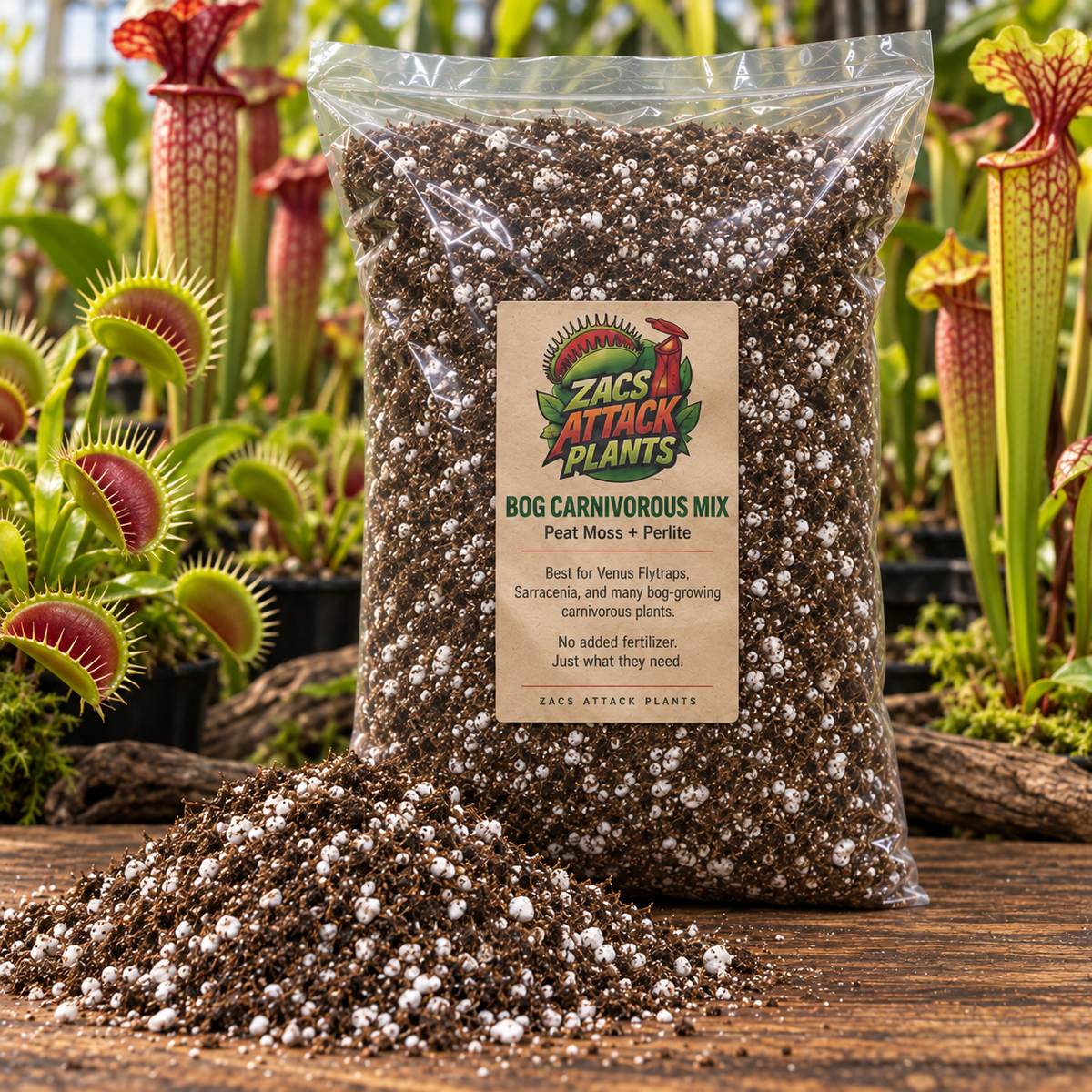
Carnivorous plant soil is not supposed to feed the plant. It is supposed to hold the right amount of water, keep enough oxygen around the roots, remain chemically lean, and stay within the moisture pattern that the species evolved to tolerate.
That is why ordinary potting mix is such a common killer. It solves the wrong problem.
First rule: do not use fertilized houseplant soil
Most commercial potting mixes contain compost, fertilizer charges, mineral amendments, or other ingredients designed for conventional plants. Carnivorous plants generally come from low-nutrient habitats and can be damaged by that concentration around the roots.
United States Botanic Garden and Royal Horticultural Society guidance both recommend specialized low-nutrient carnivorous plant media rather than garden soil or ordinary potting compost.
Bog-plant mixes: Venus flytraps, Sarracenia, and many Drosera
Traditional recipes are based on sphagnum peat, clean silica or sharp sand, perlite, or long-fiber sphagnum. The purpose is to stay acidic and wet without introducing fertilizer.
A simple starting mix is sphagnum peat with perlite or clean silica sand. Exact ratios vary among growers and species, and there is no reason to pretend one recipe is universally perfect.
If you want a simple peat + perlite blend for Venus flytraps, Sarracenia, and many common bog sundews, shop the Bog Carnivorous Plant Mix.
North Carolina State Extension describes peat-and-sand style media for Sarracenia and Drosera, and whole-fiber sphagnum or peat-based mixes for Venus flytraps.
Nepenthes need a different root environment
Nepenthes are commonly terrestrial or epiphytic tropical plants, not waterlogged bog rhizomes. Their roots appreciate moisture plus a lot of air.
Long-fiber sphagnum mixed with perlite is a simple reliable base for common hybrids. Orchid bark can make the mix more open. Clemson Extension gives an example of roughly 60 percent sphagnum, 20 percent perlite, and 20 percent orchid bark.
For common Nepenthes hybrids, shop my long-fiber sphagnum + perlite Nepenthes Potting Mix. Not sure which medium fits your plant? Compare both carnivorous plant soil mixes.
If your climate is very dry, a mix with more moisture retention may be easier. In a constantly humid greenhouse, more air space may be useful. Choose the mix for the plant and environment rather than copying a recipe blindly.
Peat-free carnivorous mixes
Peat has been a standard carnivorous plant ingredient for generations, but it is not the only possible medium. Current Royal Horticultural Society trials have reported strong Sarracenia growth in peat-free blends, including sustainably produced sphagnum-based media and sphagnum mixed with fine pine bark.
The lesson is not that every random peat-free potting mix is safe. It is that the important properties are low fertility, suitable acidity, water behavior, and root aeration.
Ingredient notes
Long-fiber sphagnum
Excellent water retention with substantial air space when kept fluffy. Commonly used for Nepenthes and many propagation setups.
Sphagnum peat
Fine, acidic, highly water-retentive material long used for bog carnivores. It compacts more than long-fiber moss and is commonly opened with sand or perlite.
Perlite
Lightweight porous material that increases air space. Use horticultural perlite without added fertilizer.
Silica or horticultural sharp sand
Adds drainage and structure to bog mixes. Avoid unknown construction sand, limestone sand, or anything that may add alkalinity or contaminants.
Orchid bark
Useful in open Nepenthes mixes. Use clean, unfertilized bark sized appropriately to the pot and root system.
When should you repot?
Repot because there is a reason, not because a plant arrived in a small nursery pot.
Good reasons include:
- The substrate has broken down and become dense
- The wrong soil was used
- Mineral buildup has become severe
- The plant or rhizome has genuinely outgrown the container
- The roots are unhealthy and you need to inspect or correct the root zone
Clemson Extension suggests repotting Nepenthes approximately every two to three years as the plant outgrows the pot or the medium breaks down.
Repotting a Nepenthes
- Prepare and moisten the new low-nutrient mix first.
- Support the vine and pitchers so they are not crushed.
- Slide the root ball out gently.
- Do not aggressively scrub every strand of old sphagnum from fine roots unless the old medium is contaminated or rotten.
- Set the plant at roughly the same depth and fill around the roots without packing the mix into a brick.
- Water through with pure water and allow it to drain.
- Return it to stable light and humidity while it recovers.
Repotting bog carnivores
For Venus flytraps and Sarracenia, late winter to early spring around the end of dormancy is a convenient time for major repotting and division because the plants are about to resume strong growth. Healthy plants can be repotted at other times when necessary, but avoid unnecessary disruption during heat or severe stress.
Common soil mistakes
- Using normal potting soil because it says "organic"
- Using fertilizer-enhanced peat or perlite
- Keeping Nepenthes in dense waterlogged muck
- Letting bog species dry because the mix drains too quickly
- Changing multiple environmental variables immediately after repotting
- Packing sphagnum so tightly that the roots lose the air space you were trying to create
The best mix is not the most complicated one. It is the one that stays chemically lean and gives that particular plant the correct balance of water and oxygen.
Research sources
Primary references included the United States Botanic Garden, Royal Horticultural Society carnivorous plant trials, North Carolina State Extension, and Clemson Cooperative Extension's 2026 Nepenthes guide.
Related guides
- Carnivorous Plant Care 101
- Best Water for Carnivorous Plants
- Perlite for Carnivorous Plants
- Sphagnum Moss for Carnivorous Plants
Browse the complete Carnivorous Plant Library for species care, propagation, water, soil, dormancy, and troubleshooting guides.