
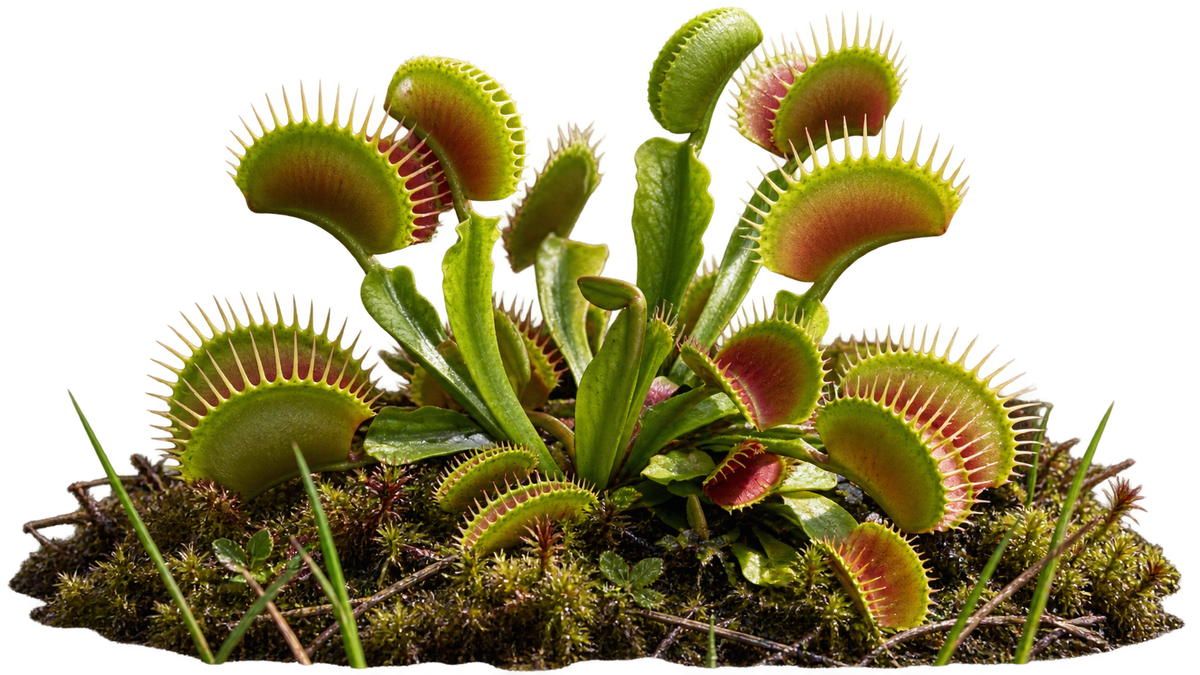
Venus flytraps are not delicate tropical houseplants. They are temperate bog plants native to a small region of coastal North Carolina and northeastern South Carolina. The easiest way to grow one well is to give it the conditions of a sunny, wet, nutrient-poor bog and allow it to rest in winter.
Light: give it real light
North Carolina State Extension lists full sun as an appropriate condition for Dionaea muscipula. Strong light produces compact growth and good trap coloration. A dim windowsill often produces weak, floppy leaves and small traps.
If a plant was greenhouse-grown or shipped in a box, acclimate it to intense outdoor sun over several days rather than moving it directly from darkness to an Alabama-style summer afternoon.
Water: keep the roots wet with low-mineral water
Use rainwater, distilled water, or reverse-osmosis water. NCSU specifically warns that hard or treated water can damage flytraps.
During active growth, a shallow tray of pure water is an easy way to keep the medium consistently moist. Do not let the pot dry completely. Reduce standing water during cool winter dormancy while keeping the medium damp.
Soil: nutrient-poor on purpose
Use a carnivorous plant medium. NCSU lists whole-fiber sphagnum or mixes based on peat with coarse sand or similar aerating material. Modern peat-free carnivorous mixes can also work when formulated specifically for these plants.
For a simple peat + perlite option made for bog carnivores, shop the Bog Carnivorous Plant Mix.
Do not use ordinary Miracle-Gro style potting mix, garden soil, compost, or fertilizer-enriched media.
Do you have to feed a Venus flytrap?
No. An outdoor flytrap catches its own insects. Feeding is supplemental nutrition, not the plant's energy source.
If you grow indoors and choose to feed, offer a small insect that fits comfortably inside the trap. Do not use hamburger, chicken, cheese, or other human food. The plant's digestion system evolved around arthropod prey.
Does triggering a trap hurt the plant?
Accidentally closing a trap is not a death sentence. The old internet rule that touching a trap once will seriously damage the entire plant is exaggerated.
That does not mean repeated triggering is free. Research published in the Annals of Botany found that mechanical stimulation and trap closure temporarily reduce photosynthesis in the trap and increase respiration, demonstrating a real energetic cost. Individual traps also have a limited working life.
So if a trap snaps while you repot or show the plant to someone, do not panic. Just do not spend the afternoon repeatedly making every trap close for entertainment.
Winter dormancy is part of the life cycle
Venus flytraps are temperate perennials. They naturally receive shorter days and cool temperatures in winter. Growth slows, older traps blacken, and the plant may become much smaller.
That seasonal decline is normal. NCSU lists the species as winter hardy through much of USDA zones 7 to 10, with protection extending cultivation colder. Potted plants can experience colder root temperatures than plants in the ground, so growers in severe climates may need protection from prolonged hard freezes.
Do not keep a flytrap warm under summer-length light all year simply because it is sold as a houseplant. A cool winter rest supports the normal yearly growth cycle.
Flowering
Mature, healthy plants can flower in spring. A small or recently stressed plant may put a lot of resources into its flower stalk. Many growers remove the stalk on weak plants and let established vigorous plants bloom.
Common problems
Black traps
Old traps naturally die. A black trap or two is not a diagnosis by itself. Look at the center growth point. New healthy leaves matter more.
Long floppy green leaves
Check light first. Weak illumination is one of the most common indoor problems.
Plant collapsing after repotting
Check the water source and potting mix, then confirm the rhizome was not buried too deeply or allowed to dry.
No traps in winter
If the plant is dormant, that can be normal. Do not try to force-feed a resting plant back into summer growth.
Venus flytrap checklist
- Strong light, ideally substantial direct sun
- Rain, distilled, or RO water
- Wet, low-nutrient carnivorous plant media
- No normal fertilizer in the root zone
- No human food in traps
- A cool winter dormancy
Research sources
This guide draws primarily from North Carolina State Extension, the Royal Horticultural Society, the United States Botanic Garden, and peer-reviewed research on the energetic cost of trap closure.
Related guides
- Venus Flytrap Dormancy
- Venus Flytrap Feeding
- Venus Flytrap Traps Turning Black
- Best Water for Carnivorous Plants
Browse carnivorous plant soil & supplies.
Browse the complete Carnivorous Plant Library for species care, propagation, water, soil, dormancy, and troubleshooting guides.