
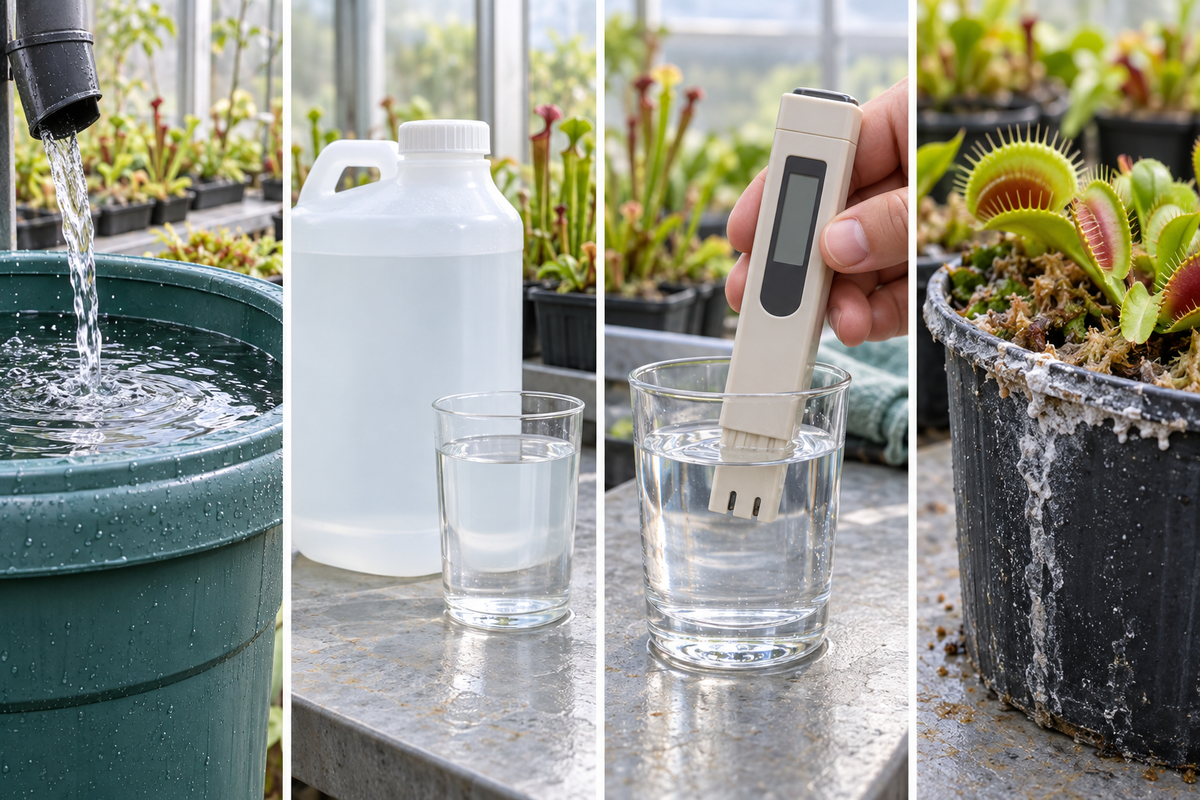
Water-quality quick guide
| Water source | Good default? | What to check |
|---|---|---|
| Clean rainwater | Yes | Use a clean roof, gutter, and container; avoid contaminated runoff. |
| Distilled water | Yes | Choose plain distilled water, not mineral or electrolyte water. |
| Reverse-osmosis water | Yes | Retest periodically because worn filters and membranes raise output TDS. |
| Tap water | Sometimes | Test it. Aim below about 50 ppm TDS when practical; 50–100 ppm deserves caution and monitoring, while consistently higher readings are a poor long-term default for most carnivorous plants. |
| Refrigerator-filtered water | Usually not | Carbon filters often improve taste without removing dissolved hardness. |
| Household softened water | No | Softening commonly replaces calcium and magnesium with sodium. |

AI-generated educational illustration: common water sources, TDS screening, and visible mineral buildup. Confirm suitability with the written water-quality guidance.
Important: TDS is a screening tool, not a complete chemical analysis. A low reading is useful, but it does not identify which minerals are present. When the source is uncertain, rain, distilled, or RO water remains the safer choice.
How to check water with a TDS meter
- Rinse the meter with distilled or RO water.
- Test a clean sample before it touches the pot.
- Record the result and retest the same source every few weeks if you use an RO system.
- If you are troubleshooting mineral buildup, compare the source water with water draining from the pot. A much higher runoff reading can point to accumulated salts or deteriorating media.
If a carnivorous plant gets the right light and soil but slowly declines anyway, water quality is one of the first things worth checking. These plants evolved in habitats where the root zone is often wet but surprisingly poor in dissolved minerals.
The simple answer is easy: rainwater, distilled water, and reverse-osmosis water are the safest defaults.
Why ordinary tap water can become a problem
Water carries dissolved minerals. Every time you water a pot and some of that water evaporates, a portion of the dissolved material can remain behind in the substrate. Repeated over months, this can raise the mineral concentration around roots that evolved for low-nutrient conditions.
The United States Botanic Garden recommends rainwater, melted snow, or distilled water instead of tap or mineral water for carnivorous plants. North Carolina State Extension gives the same basic warning for Venus flytraps, Sarracenia, and Drosera.
Rainwater
For most growers, clean collected rainwater is excellent. It is naturally low in dissolved salts and is recommended by major horticultural institutions for carnivorous plants.
Use a clean collection container. If the water has been sitting for a long time full of algae, debris, or contamination, clean the container and start fresh.
Distilled water
Distillation removes almost all dissolved mineral content, which makes grocery-store distilled water one of the simplest choices for a small collection. The downside is cost and the amount of plastic involved if you use many gallons per week.
Reverse-osmosis water
RO systems push water through a membrane that removes most dissolved material. For a larger collection, an RO unit can be much cheaper than buying gallon jugs constantly.
RO performance depends on the starting water, membrane condition, pressure, and system design. If output mineral content begins climbing, it may be time for filters or membrane maintenance.
What about filtered refrigerator water?
A carbon refrigerator filter is not the same as reverse osmosis. Many filters improve taste and remove chlorine compounds but leave much of the dissolved hardness behind. Unless you know what the filter removes and have tested the output, do not assume filtered tap water is automatically safe for carnivorous plants.
What about boiled tap water?
Boiling can remove volatile disinfectants, but it does not make dissolved mineral salts disappear. In fact, evaporation can concentrate minerals in the water that remains. Some horticultural advice allows cooled boiled water as an emergency alternative, but rain, distilled, or RO water is a much cleaner long-term solution for mineral-sensitive carnivorous plants.
Never use household softened water
Water softeners typically exchange calcium and magnesium for sodium. That can make the water feel softer to people while making it a poor choice for salt-sensitive plants. Use water from before the softener, then treat it with RO if needed, or use another pure source.
Do you need a TDS meter?
A TDS meter is useful, especially if you are running an RO system or trying to understand a tap-water source. It estimates the amount of dissolved material by measuring electrical conductivity.
Do not treat one internet ppm number as a universal biological cliff. TDS tells you how much conductive material is present, not exactly what those dissolved substances are. Lower-mineral water is the safer direction, but the plant genus, substrate, evaporation rate, and watering method also affect how quickly salts build up.
Watering methods by plant
Venus flytraps, Sarracenia, and many Drosera
These are bog-associated plants. During active growth, many growers keep their pots in a shallow tray of pure water so the medium stays constantly moist.
Nepenthes
Water thoroughly from the top and let excess drain. Keep the medium moist but airy. Most Nepenthes should not sit permanently in a deep water tray.
If you accidentally used tap water
One accidental watering is not a reason to throw the plant away. Switch back to low-mineral water. If hard water was used repeatedly, flushing a free-draining pot with plenty of pure water and eventually replacing badly mineralized media may help, depending on the plant and substrate.
Do not let a plant completely dry out while waiting to buy perfect water. Acute dehydration can also cause damage. Fix the water source as soon as practical and get back to consistent care.
The practical answer
- Best cheap source: clean rainwater
- Best easy small-collection source: distilled water
- Best long-term large-collection source: reverse osmosis
- Use cautiously: tap water only when you know its mineral content is appropriately low
- Avoid: mineral water and household softened water
Research sources
This guide was researched from United States Botanic Garden cultivation guidance, North Carolina State Extension, Royal Horticultural Society water guidance, and International Carnivorous Plant Society cultivation literature.
Related guides
- Carnivorous Plant Care 101
- Carnivorous Plant Soil & Repotting Guide
- TDS and PPM for Carnivorous Plant Water
- Mineral Burn in Carnivorous Plants
Browse the complete Carnivorous Plant Library for species care, propagation, water, soil, dormancy, and troubleshooting guides.