
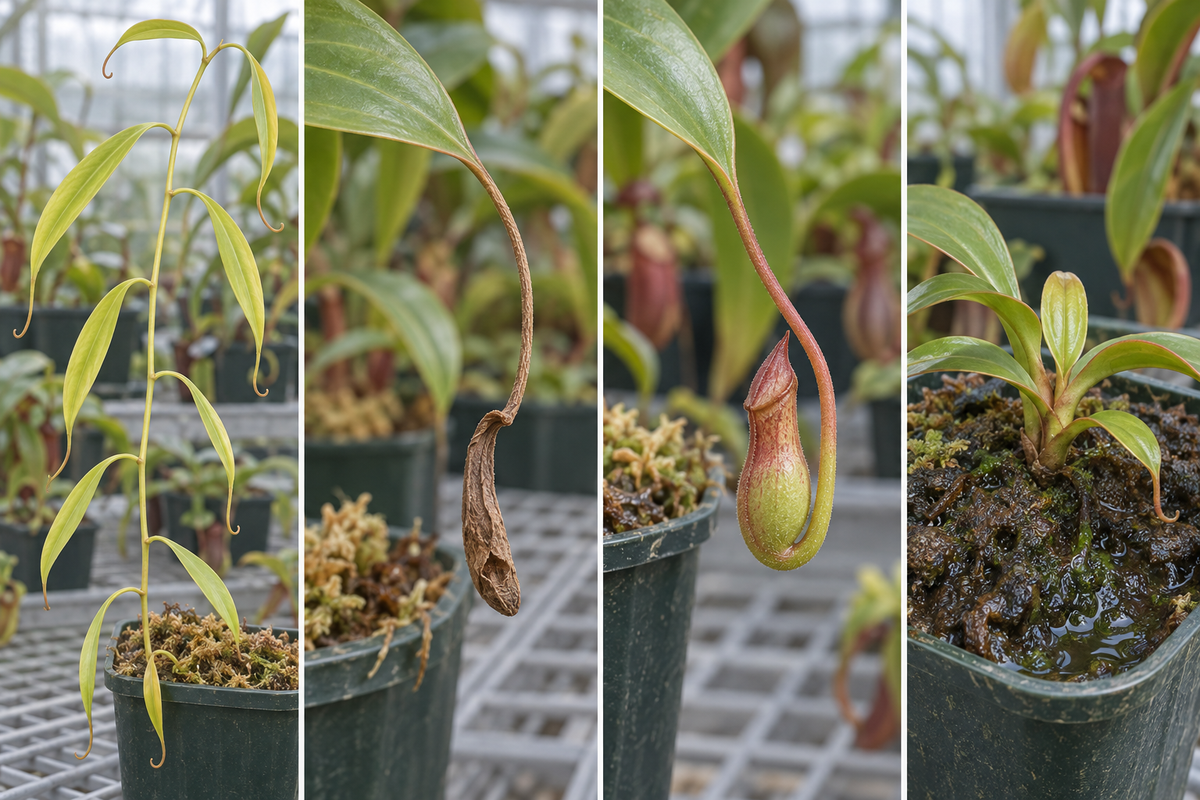
Fast diagnosis: match the symptom to the first check
| What the plant is doing | Check first | Why |
|---|---|---|
| Long green vine, wide spacing between leaves, no swelling tendrils | Light | The plant may have enough energy for leaves but not traps. |
| Tendril tips repeatedly form and dry out | Root moisture, drafts, and stable humidity | Developing traps are sensitive to abrupt dehydration and environmental swings. |
| Old pitchers died after delivery, but new leaves are normal | Acclimation time | Greenhouse-grown pitchers often fail while the plant adjusts to a new room. |
| New leaves are smaller and the pot stays wet for days | Roots and media | Compacted or sour media can stall the whole plant. |
| New growth is distorted or scarred | Pests | Thrips and mites often attack the tissue that would form the next pitcher. |
| Rapid leafy growth began after heavy feeding | Fertilizer | Excess nitrogen can favor leaves over pitchers. |

AI-generated educational illustration: common pitcher-development clues. Use the next leaf and tendril to judge whether a care change is helping.
Use the next leaf as your test
After correcting the most likely cause, hold the other variables steady and label the newest leaf. Improvement should appear in growth produced after the change, not in an old tendril that already stopped developing. Depending on temperature and growth rate, useful evidence may take several weeks.
A Nepenthes can look green, keep making leaves, and still refuse to make a single pitcher. That does not automatically mean the plant is dying. Pitcher production is one of the first things many Nepenthes reduce when the environment is only good enough for basic leaf growth.
Work through the causes in order instead of changing everything at once.
1. Check light first
Inadequate light is one of the most common causes of pitcherless Nepenthes. Clemson Extension recommends bright indirect light, while experienced commercial growers also repeatedly identify insufficient light as the first thing to troubleshoot.
Signs that light may be too weak include long soft green growth, large spacing between leaves on a climbing vine, and tendrils that repeatedly form but never inflate.
Increase light gradually. A plant moved suddenly from low light into intense sun can burn before it has time to adapt.
2. Check temperature and drafts
Nepenthes species come from different elevations. Lowland species want warm nights, while highland species need a meaningful nighttime temperature drop. Common hybrids tolerate a wider range, but they still dislike being blasted by a heating vent, air conditioner, or cold window draft.
If pitcher loss started when the seasons changed or the HVAC began running, inspect the plant's actual location before buying new equipment.
3. Consider acclimation
Shipping can completely change a plant's humidity, temperature, light, airflow, and watering rhythm in a matter of days. Existing pitchers were built for the old environment and often brown after arrival.
If the growth point is healthy and the plant is making new leaves, give it time to build pitchers adapted to your conditions. Avoid repotting a healthy newly shipped plant just because the old pitchers look rough.
4. Inspect roots, media, and watering
A Nepenthes can stay green for a while even while the root zone is becoming a problem. Dense broken-down media, constant standing water, a badly rootbound pot, or aggressive repotting can all interrupt pitcher production.
The medium should stay moist but airy. Water thoroughly and drain. If the pot smells sour, remains saturated for an unusually long time, or the plant has stalled completely, root health moves higher on the suspect list.
5. Check humidity, but do not treat it as the only variable
Clemson Extension recommends humidity above about 60 percent for many indoor Nepenthes and notes low humidity as a common cause of poor pitcher development. That is useful guidance, but humidity is not the only answer.
Some tolerant hybrids adapt to ordinary home humidity when light and roots are good. Other plants are much pickier. If tendril tips repeatedly dry before inflating, stable higher humidity may help.
Brief misting is not the same as maintaining higher ambient humidity. If humidity is truly limiting, a humidifier, greenhouse cabinet, or grow space with controlled humidity changes the environment more meaningfully.
6. Review feeding and fertilizer
A starving-looking pitcherless plant usually needs environmental correction before more fertilizer. Too much nitrogen can encourage rapid leafy growth without proportional pitcher production.
Carnivorous Plant Newsletter cultivation literature specifically warns that overfertilized Nepenthes may grow very fast while producing fewer pitchers. If the plant suddenly became a leaf machine after you increased feeding, back off and let the plant rebalance.
7. Give mature vines something to work with
On some mature climbing Nepenthes, tendrils that contact or wrap around support can develop more reliably than unsupported tendrils. This is not the first fix for a young rosette, but it is worth considering for a long established vine after light, temperature, roots, and acclimation are already correct.
A good troubleshooting order
- Light
- Temperature and HVAC drafts
- Recent shipping or environmental change
- Root health, watering, and old media
- Humidity
- Excess feeding or fertilizer
- Tendril support on mature vines
What not to do
- Do not repot, move, fertilize, and radically increase light on the same day.
- Do not keep the pot standing in water just to increase humidity.
- Do not assume every lost shipping pitcher means root rot.
- Do not feed heavily to compensate for low light.
- Do not expect an old greenhouse-grown pitcher to adapt. Watch the new growth.
For common beginner hybrids
Ventrata, Miranda, and St. Gaya are relatively forgiving. If one of these is making healthy leaves but no pitchers, I would usually investigate light and the root environment before assuming it needs rare-species humidity or a complicated temperature system.
For the full baseline setup, read the Nepenthes Care Guide.
Research sources
This article was researched from Clemson Cooperative Extension's 2026 Nepenthes guide, Royal Horticultural Society cultivation guidance, current long-running nursery troubleshooting material, and Carnivorous Plant Newsletter cultivation literature.
Related guides
Browse the complete Carnivorous Plant Library for species care, propagation, water, soil, dormancy, and troubleshooting guides.