
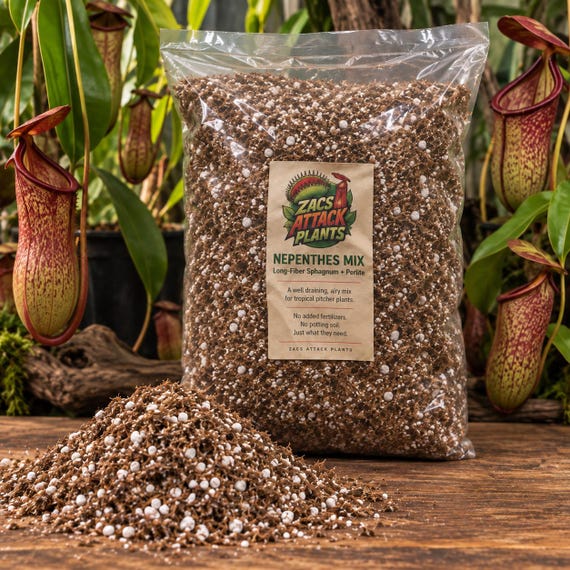
Nepenthes are often repotted because the media has broken down, the plant has outgrown its container, drainage has worsened, or the root zone needs inspection. The goal is not to scrub every root clean. It is to move the plant into fresh, suitable media while disturbing healthy roots as little as practical.
Choose an airy medium
There is no single Nepenthes mix for every species. Long-fiber sphagnum is commonly used, often with coarse materials such as perlite or bark to increase air space. Whatever mix you choose should hold moisture while still draining freely.
For common hybrids such as Miranda, St. Gaya, and Ventrata, shop my long-fiber sphagnum + perlite Nepenthes Potting Mix.
Prepare first
Moisten the new media with low-mineral water before starting. Have the new pot ready so the root system is not left exposed while you search for supplies. A pot with plenty of drainage is important.
Remove the plant gently
Support the stem near the base and ease the root ball from the pot. If roots are attached to old sphagnum, do not aggressively tear every strand away. Remove loose or badly degraded material, but preserve healthy roots whenever possible.
Set the plant at the same depth
Position the root system naturally and fill around it without crushing the media into a dense brick. The stem base should not be buried much deeper than it was before. Water through the pot after repotting so the media settles around the roots and excess drains away.
Aftercare
Keep conditions stable for the next several weeks. Avoid a sudden jump in light intensity, aggressive feeding, or repeated moving while the roots recover. Some temporary loss of older pitchers can happen after root disturbance.
When not to repot
If the media is still fresh, drainage is good, and the plant is growing well, repotting just because a calendar says so may be unnecessary. Nepenthes vary in growth rate and root mass. Repot because the plant or media needs it, not because every plant must be repotted on the same date.