
Direct answer for Drosera spatulata: most commonly cultivated forms are subtropical and do not need a cold winter dormancy. They can grow year-round with suitable light and temperatures, although they may slow or look smaller under weak winter light. The location or named form still matters, so keep the plant label when one is available.
Drosera dormancy by group
| Group | Common examples | Seasonal behavior | Main care change |
|---|---|---|---|
| Tropical/subtropical | D. spatulata, D. capensis, D. aliciae | Usually evergreen; may slow in winter | Keep moist and bright; do not force a cold dormancy. |
| Temperate | D. rotundifolia, many D. intermedia and D. anglica forms | Forms a tight winter hibernaculum | Provide a cool seasonal rest and keep the medium damp. |
| Tuberous | Many Australian tuberous Drosera | Often grows in the cool wet season and rests as a tuber during heat or drought | Reduce water according to the species once top growth naturally dies back. |
| Pygmy | Small southwestern Australian species | Often produces gemmae with shorter days and may slow in heat | Follow species-specific seasonal watering; gemmae production is not temperate hibernation. |
| Petiolaris complex | Northern Australian woolly sundews | May enter a warm, drier-season resting phase | Keep warm and avoid treating it like a cold-temperate hibernaculum. |

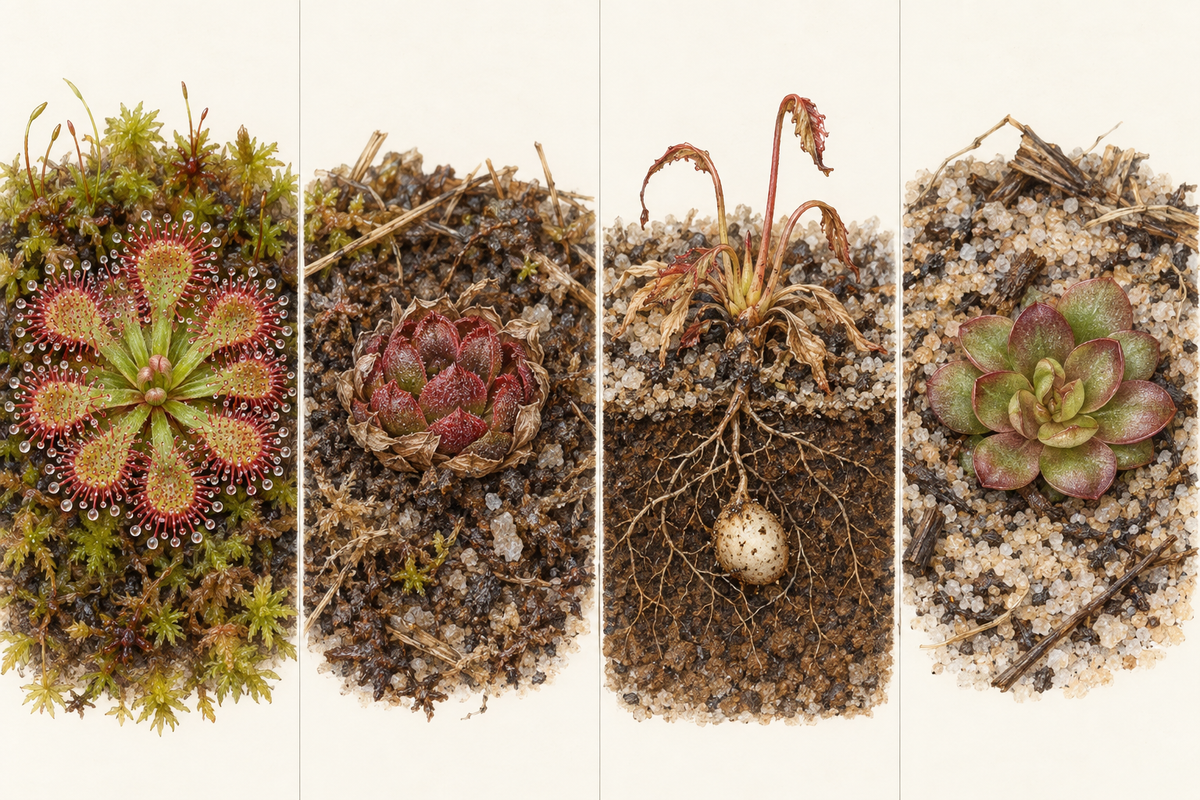
AI-generated educational illustration: contrasting Drosera growth and dormancy structures. Identify the species before changing temperature or watering.
Dormant or dying?
A healthy temperate hibernaculum is compact and firm at the crown. A tuberous species may lose all visible foliage while the underground tuber remains alive. By contrast, a black or mushy crown, sour-smelling media, and damage that spreads rapidly are warning signs rather than normal dormancy. If a tropical D. spatulata collapses in warm conditions, investigate light, water quality, heat, pests, and root health instead of assuming it is resting.
Before changing winter care
- Confirm the species and, if possible, its location or cultivar.
- Note whether the change followed shorter days, heat, drought, shipping, or repotting.
- Compare the plant with photographs of the correct dormant structure—hibernaculum, tuber, resting bud, or reduced tropical rosette.
- Change temperature and water gradually; do not swing a stressed plant between saturated warmth and sudden cold.
“Sundew” describes hundreds of Drosera species spread across very different climates. Some grow year-round in warm conditions, some form winter resting buds, and others disappear underground during a dry or hot season. A single dormancy recipe cannot safely cover the whole genus.
Tropical and subtropical sundews
Common species such as many forms of Drosera capensis, D. spatulata, and related tropical or subtropical plants are often grown continuously when light and temperatures remain suitable. They may slow under poor winter light without entering the same type of dormancy as a temperate species.
Temperate sundews
Many temperate Drosera form compact resting buds called hibernacula as cold weather approaches. Their summer leaves die back while the protected bud remains alive until spring conditions return. Keeping these plants warm and actively growing all winter can conflict with their natural seasonal cycle.
Tuberous and seasonally dormant Drosera
Some Australian and South African sundews follow almost the opposite schedule from a typical temperate garden plant. Certain species grow during cool wet seasons and retreat into underground tubers or roots during hot dry periods. Watering these exactly like a tropical sundew through dormancy can cause losses.
Pygmy sundews are different again
Pygmy Drosera can produce gemmae, small vegetative propagules, in response to seasonal cues. Their growth pattern is another reminder that “Drosera care” has to be species-specific.
What should you do?
- Identify the species or hybrid.
- Find out whether it is tropical, temperate, tuberous, pygmy, or another seasonal type.
- Match temperature and moisture to that growth cycle.
- Do not force a dormant plant into active growth simply because the foliage looks reduced.
If a sundew suddenly disappears, do not assume it is dead until you know how that species handles dormancy. The correct response for a tropical D. capensis can be completely wrong for a tuberous or temperate Drosera.
Related guides
Browse the complete Carnivorous Plant Library for species care, propagation, water, soil, dormancy, and troubleshooting guides.