
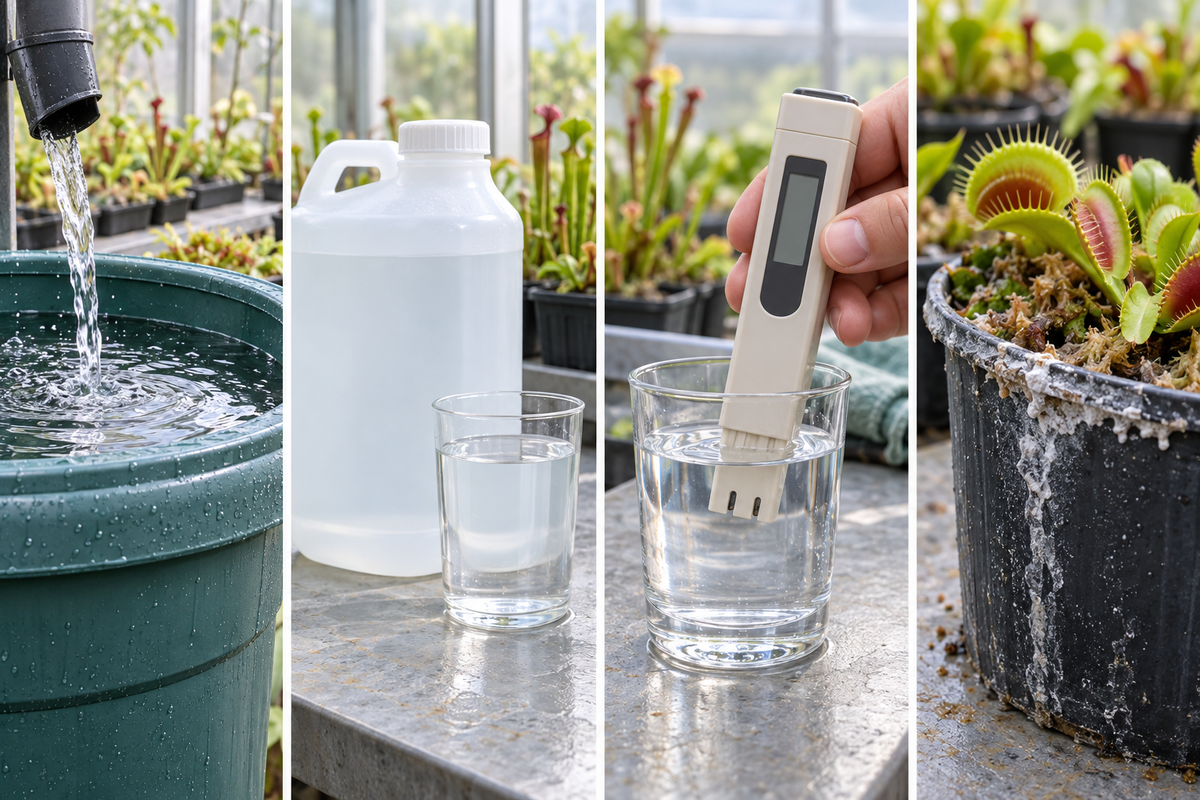
Many carnivorous plants come from habitats where their roots receive very little dissolved nutrition. That is part of why they evolved ways to obtain nutrients from prey. In a pot, repeated watering with mineral-rich water can concentrate salts as water evaporates.
What mineral stress can look like
There is no single visual symptom that proves mineral burn. Possible signs include brown leaf tips, declining roots, poor new growth, loss of vigor, or a white mineral crust on the media or pot. Those symptoms can also have other causes, so look at water history and the entire plant.
Use a low-mineral water source
Rainwater, distilled water, and properly functioning reverse-osmosis water are widely used for carnivorous plants. They minimize the amount of dissolved material added to the pot with every watering.
Tap water is not identical everywhere
Some tap water is naturally soft and low in dissolved minerals; other supplies are extremely hard. The fact that tap water works for one grower does not mean it will work at another address. If you want to evaluate a source, measure it and check your local water report rather than guessing.
Fertilizer can add salts too
Standard potting mixes and fertilizers are designed for ordinary plants and may contain nutrient levels that are inappropriate for sensitive carnivorous plants. Use species-appropriate media without added fertilizer unless you are deliberately following a proven fertilization method.
If you suspect buildup
Switch to low-mineral water and flush suitable freely draining media thoroughly. If the medium is old, compacted, or heavily contaminated, repotting into fresh appropriate material may be needed. Be careful not to add severe root disturbance to a plant that is only mildly stressed.
Prevention is easier than correction: know what is in your water, use appropriate media, and avoid treating carnivorous plants like ordinary heavy-feeding houseplants.