
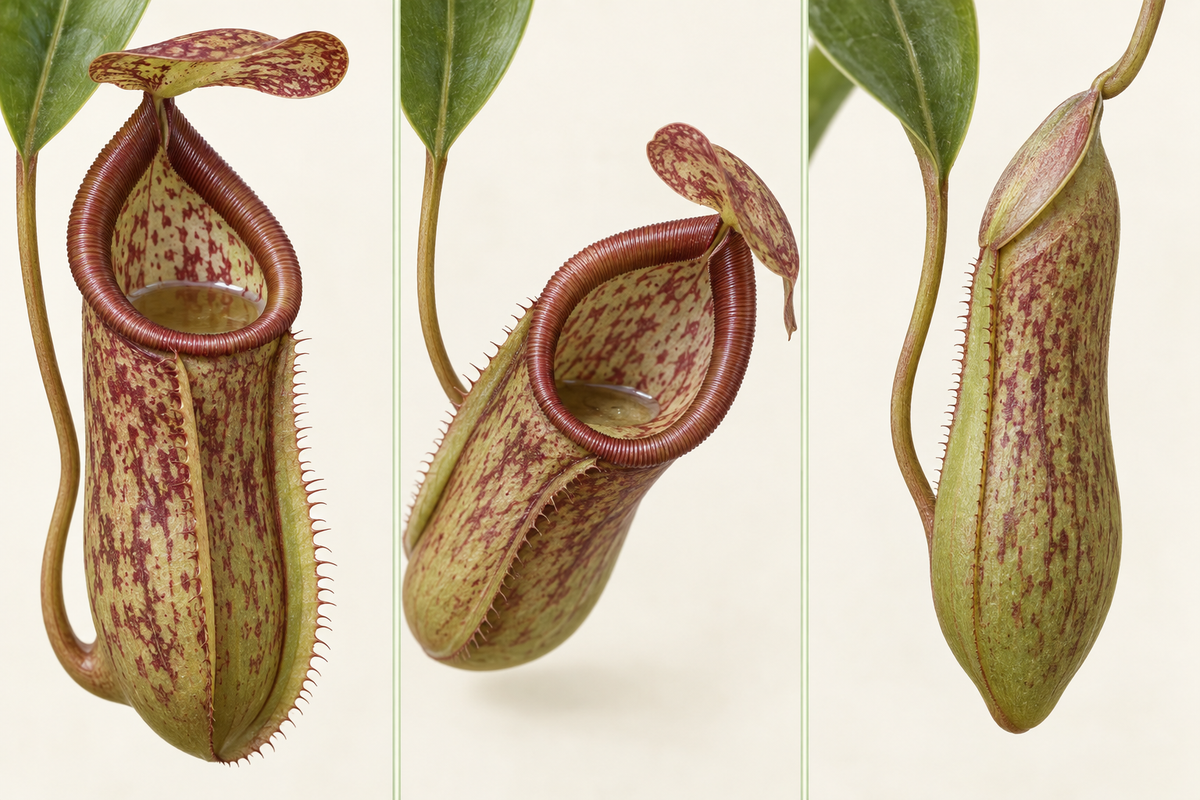
Quick answer: Do not routinely fill healthy Nepenthes pitchers. A newly opened pitcher normally makes its own digestive fluid. If a healthy pitcher was emptied during shipping, adding a small amount of distilled, rain, or reverse-osmosis water is optional; do not fill it to the rim.
Nepenthes pitcher-fluid decision table
| What you see | What it usually means | What to do |
|---|---|---|
| New pitcher with fluid | Normal trap development | Leave it alone. |
| Healthy pitcher emptied in transit | The fluid spilled | Leave it alone or add only enough low-mineral water to wet the bottom—roughly no more than one-quarter full. |
| Several new pitchers repeatedly open dry | Possible dehydration, root stress, or unstable growing conditions | Check root moisture, temperature, airflow, light, and recent acclimation. |
| Pitcher browns from the lid downward | Usually aging or environmental stress | Do not try to reverse it by filling the pitcher. Judge the plant by its newest leaves and pitchers. |
| Pitcher smells rotten or contains black, mushy tissue | Dead tissue or decay | Trim the dead pitcher with clean scissors once it is mostly brown. |

AI-generated educational illustration: normal pitcher fluid, shipping loss, and a sealed developing pitcher. Use the written diagnostic details with the image.
Why the amount of fluid varies
Pitcher-fluid level is not identical across every species, hybrid, or trap. It can change as a pitcher ages, catches prey, loses water through evaporation, or is tilted. Compare several newly opened pitchers on the same plant instead of diagnosing the plant from one old trap.
A pitcher that is still sealed has not finished opening. Do not pry it open or add water. After the lid opens, the trap continues maturing on its own.
When an empty pitcher points to a larger care problem
One spilled pitcher is not concerning. Repeated dry or aborted pitchers are more useful evidence. Check whether the potting mix is staying evenly moist but airy, whether the plant sits in a heating or air-conditioning draft, and whether the newest leaf is smaller than the last. Those patterns can indicate root or environmental stress that adding water to the trap will not solve.
A healthy Nepenthes pitcher normally develops its own internal fluid. That liquid is part of the trap: prey falls into the pitcher, and nutrients are released and absorbed as digestion proceeds.
Do healthy pitchers need to be filled?
Usually, no. Newly formed pitchers are designed to produce and regulate their own fluid. Routine filling can unnecessarily dilute what the plant has produced, so there is no reason to top every pitcher up like a vase.
What if the pitcher spilled during shipping?
Shipping can tip a plant and empty some pitchers. If a pitcher is otherwise healthy, you can generally leave it alone. Some growers add a small amount of low-mineral water to an emptied pitcher to keep the interior from drying excessively, especially after transport. If you do, use only a modest amount rather than filling the pitcher to the rim.
Rainwater, distilled water, or reverse-osmosis water is a safer choice than mineral-heavy tap water.
Brown pitchers are not always a fluid problem
Pitchers are temporary leaves and eventually age. They can also decline after a sudden change in light, humidity, temperature, or handling. Adding water will not reverse a pitcher that is already naturally senescing.
Should you pour fertilizer into the pitcher?
Do not casually pour concentrated fertilizer into pitchers. Nepenthes can obtain nutrients through prey and, in some cultivation systems, carefully controlled feeding or fertilization. Excess concentration can damage pitcher tissue and roots. If you choose to fertilize, follow a method intended specifically for Nepenthes and start conservatively.
Simple rule
If a pitcher formed normally and still contains fluid, leave it alone. If shipping emptied it, a little clean water is optional, not mandatory. Focus on getting the whole plant into stable light, temperature, humidity, and root moisture so the next pitchers form normally.
Related guides
- Nepenthes Care Guide
- Should You Feed Nepenthes?
- Nepenthes Acclimation After Shipping
- Best Water for Carnivorous Plants
Browse the complete Carnivorous Plant Library for species care, propagation, water, soil, dormancy, and troubleshooting guides.